□
Search and clear a mark for use
prior to using it.
□ In written
materials, use a mark properly by following these guidelines :
--Except when
case is truly part of the design (i.e., eBay, FedEx), generally
distinguish trademarks by referring to them in ALL CAPS.
--When the ® symbol is
used, place
it directly after the registered trademark and superscripted.
--Avoid using the ® symbol when goods or services properly bearing the symbol will be transmitted into a country in which the mark is not registered. In that event, take action to search and register the mark in the given country and use the superscripted TM until the mark is registered in that country. Avoid using the ® symbol for marks which are not nationally registered in a given country.
--Trademarks
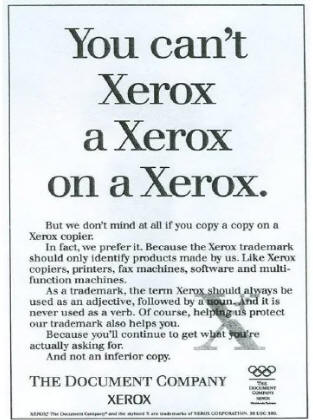
should not be used as verbs.
--Trademarks
should not be used in the possessive form unless the trademark
itself is possessive.
--Trademarks
should not be used as nouns, but rather should always be followed by a descriptive noun. Here is one
example of efforts to avoid improper noun or verb usage of a
trademark:
□ Provide advance copies/mock-ups of
your advertising and packaging materials to counsel for review
prior to using the same on your goods or services for the first
time.
□ If appropriate, register the mark in
the United States and foreign jurisdictions desired, and make all
renewal and maintenance filings on time. With
regard to any incontestability filings, be sure to have
those filings perfected as soon as the registration is eligible,
as opposed to waiting until the end of the filing window.
□ Where
appropriate, faithfully use
the ® symbol to denote your registered marks and the ™
symbol to denote unregistered marks. This can be crucial, especially if a competitor
were to register your mark(s), or a confusingly similar mark(s),
before you have attended to such a filing. For information on
how to properly use designations and marking
click here:
□ When applying to register a mark, be
painstakingly accurate about your first use date and the
description of all goods/services pertaining to the given first
use date for each items of goods/services.
□ Consider registering related
internet domain names in various forms, and
various top level extensions.
□ Consider having your trademark
registrations also registered with United States Customs and
Border Patrol to help prevent the importation of counterfeit
or infringing merchandise that bears your trademark and harms
your trademark rights.
□ Police your rights in the
mark. Consider instituting your own regular review of the market
place and key internet sources such as google.com, froogle.com,
yahoo.com, dogpile.com, eBay.com, amazon.com, and review
national current news sources, industry specific publications,
telephone white page and yellow page listings, and press release
databases such as prweb.com, prnewswire.com.
□ When permitting others to use your
mark, have reasonable written quality controls, over, for
example, the nature, characteristics, quality, duration, and
extent of
such use.
□ When acquiring a mark, make sure
that the "goodwill" is also a part of the transaction and
is conveyed with the mark.
□ Maintain reasonable awareness of the
marketplace and potential conflicting uses. Be alert.
□ Monitor newly filed or
pending trademark applications which do or could adversely
affect your rights.
□ Take action to oppose
conflicting third party applications, and to cancel
conflicting third party registrations.
□ When advisable, take
action via legal counsel to contact infringers, resolve
infringing use, and file a lawsuit suit if necessary.
□ Avoid abandonment of the mark
that may result from non-use or interrupted use of the mark.
□ Avoid abandonment of the mark
that may result from generic use of the mark (for example using a noun form
of the mark). A trademark owner’s product or service may
become so popular that consumers are tempted to use it as the
generic name of the product or service being marketed (e.g.,
KLEENEX for facial tissues, BAND-AID for bandages, or XEROX for
photocopies). A trademark that is generic is no longer
distinctive because it ceases to identify the source of the
product or services sold under that mark. It should therefore
generally be used as an adjective when describing the
claimed goods or services, and never as a noun or as the name of
the product.
□ Avoid abandonment of the mark
that may result from making material changes in the mark. If a mark is evolving or
changing, file a new trademark application(s) tailored to your
use or intended use of the mark.
□ Avoid changing the types of
goods or services offered under the registered mark. File a new trademark application(s) tailored to your use or intended use of the mark
with respect to new or different goods and services than those
set forth in your registration.